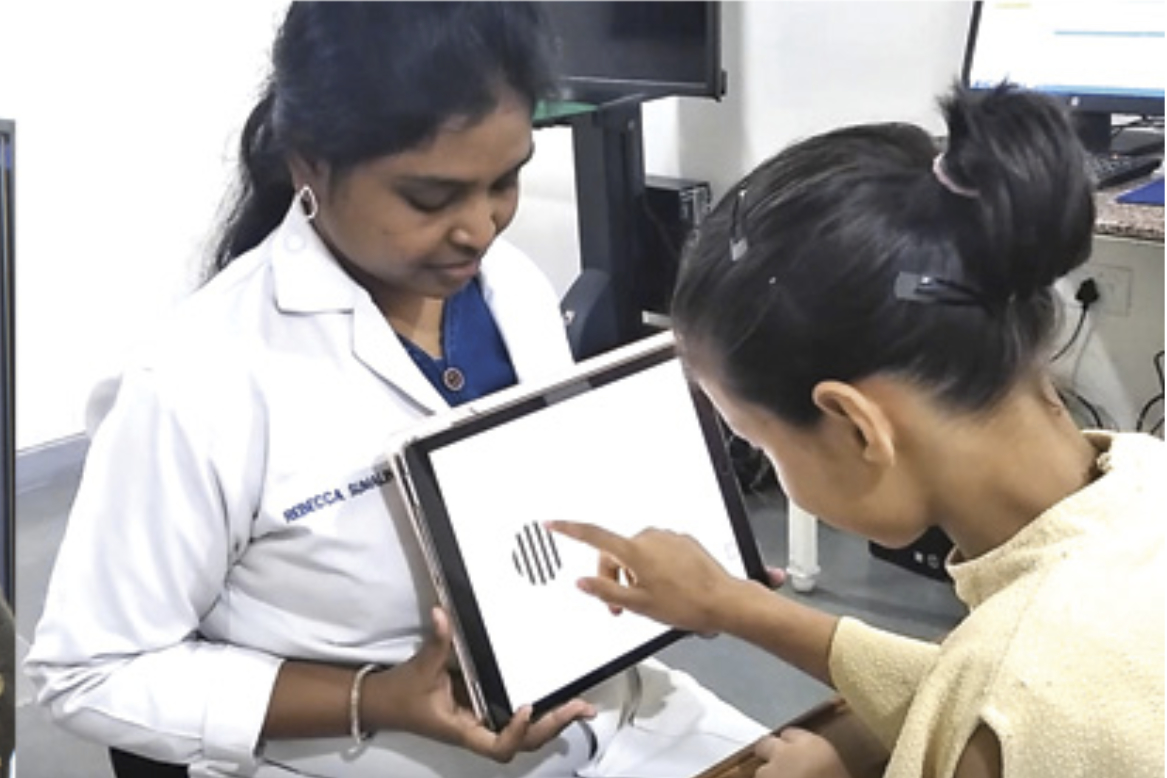


A new study led by Rebecca Sumalini and colleagues at LVPEI, in collaboration with Rainbow Children’s Hospitals and City St. George’s, University of London, report that Teller Acuity Cards-II and Ohio Contrast Cards perform better than other alternatives in assessing grating acuity and contrast sensitivity in children with cerebral visual impairment.
Vision is a function of the eyes and the brain working together. Damage to visual pathways or visual processing areas of the brain results in cerebral visual impairment (CVI). It is a growing cause of vision impairment in children, where they may have trouble recognizing faces or objects, or maintaining eye contact. They respond slowly to visual cues or compulsively gaze at a bright light. Such variability makes measuring visual functions difficult in these children. Standard eye charts require naming letters or matching symbols – tasks that involve attention, coordinated movements, and communication – which may be challenging for children with CVI. Clinicians, therefore, need to rely on alternative approaches to assess visual functions in them.
In infants and children who are too young to verbalize a response to charts, two methods are commonly used. One is a grating acuity test where children are asked to distinguish white and black stripes on a grey background that become progressively thinner to determine the smallest pattern they can detect. The other is a contrast sensitivity test that uses faces/patterns in decreasing shades of grey to determine how faint a contrast the child can detect. Teller Acuity Cards-II (TAC-II), the Peekaboo Vision App, Hiding Heidi cards and Ohio Contrast Cards (OCC) are examples of commonly used testing tools in children. Originally designed for pre-communicative children, these tools are being adapted for children with special needs. But how well do they perform in children with CVI, and how repeatable are the findings of these tools?
In a new study published in Vision Research, Rebecca Sumalini, as part of her doctoral research along with her mentors from LVPEI, in collaboration with Rainbow Children’s Hospital and City St. George’s University of London, examined 111 children with CVI and 50 children without CVI (controls), aged between 6 months and 7 years. The researchers compared TAC-II cards with the Peekaboo Vision app for grating acuity and Hiding Heidi cards with OCC cards for contrast sensitivity. They assessed how many children successfully completed the tests (testability), how consistent the results were when repeated (repeatability), and whether the paired tools produced similar scores for the same child (measured by limit of agreement).
Among children with CVI, TAC-II cards showed higher testability (95.4%) compared to Peekaboo Vision app (82.8%) and better repeatability. For contrast sensitivity, Hiding Heidi cards and OCC showed comparable testability, and the latter was noted to have better repeatability. The researchers also found that the paired tests gave different results; indicating that the tools cannot be used interchangeably, especially when monitoring a child’s vision over time. The study findings indicated better repeatability of the tools in controls compared to children with CVI, underscoring the need for careful interpretation of visual function measures over time in children with CVI. As one of the largest studies to test these tools in children with CVI, the findings provide guidance for selecting the right tools while assessing commonly measured visual functions in this group.
‘Assessing children with CVI is inherently challenging due to the variability within this population. In this study, we validated clinical tools and established repeatability indices for two commonly assessed visual functions, grating acuity and contrast sensitivity. This supports more accurate interpretation and contributes toward standardizing clinical assessment protocols for children with CVI’, says Dr. Rebecca Sumalini, consultant optometrist at LV Prasad Eye Hospital and first author of the paper.
Citation
Sumalini R, Subramanian A, Conway ML, Lingappa L, Satgunam P. Validation of clinical tools to measure grating acuity and contrast sensitivity in children with cerebral visual impairment. Vision Res. 2026 Mar;240:108747. doi: 10.1016/j.visres.2025.108747. Epub 2025 Dec 20. PMID: 41422679.
Photo credit: LVPEI