

Dr Brijesh Takkar and his colleagues from the Anant Bajaj Retina Institute–Srimati Kanuri Santhamma Centre for Vitreoretinal Diseases; Indian Health Outcomes, Public Health, and Economics Research (IHOPE) Centre; Prof. Brien Holden Eye Research Centre, L V Prasad Eye Institute, reviewed the literature for evidence on the changes to gut microbiome due to Diabetes, and the possible link between gut dysbiosis and Diabetic Retinopathy (DR).
Diabetes mellitus (DM) is a chronic, metabolic disease affecting close to 537 million people around the world. Nearly 35% of people with DM have Diabetic Retinopathy (DR), a sight-threatening sequala that damages retinal vasculature. Diabetic retinopathy, especially vision-threatening DR, is a progressive disease with a long development period and is incurable once it sets in. A lot of health systems effort is therefore directed towards identifying potential and early incidence of DR, and to measures that can prevent progression.
Gut microbiota is a fascinating and new potential target for preventing DR progression. Various studies have been tracking the variations in gut microbial diversity among those with DM compared to healthy controls. Microbial action can enhance or tamp down gut inflammation leading to obesity, which is closely linked to diabetes. Some gut bacteria can decrease insulin resistance and increase glucose intake, alter carbohydrate metabolism, or induce fatty acid metabolism, reducing obesity. All these discoveries are only now adding up to preclinical trials and potential therapies to tackle DM. The relationship between Diabetic Retinopathy and the gut—the ‘gut-retina axis’—is relatively under-explored. Previous papers from LVPEI have documented significant differences in the gut microbiomes of people with and without Type 2 Diabetes. They have also noted phyla-level differences in those with DR when compared to healthy controls and people with diabetes. However, the evidence connecting gut dysbiosis to DR remains inconclusive.
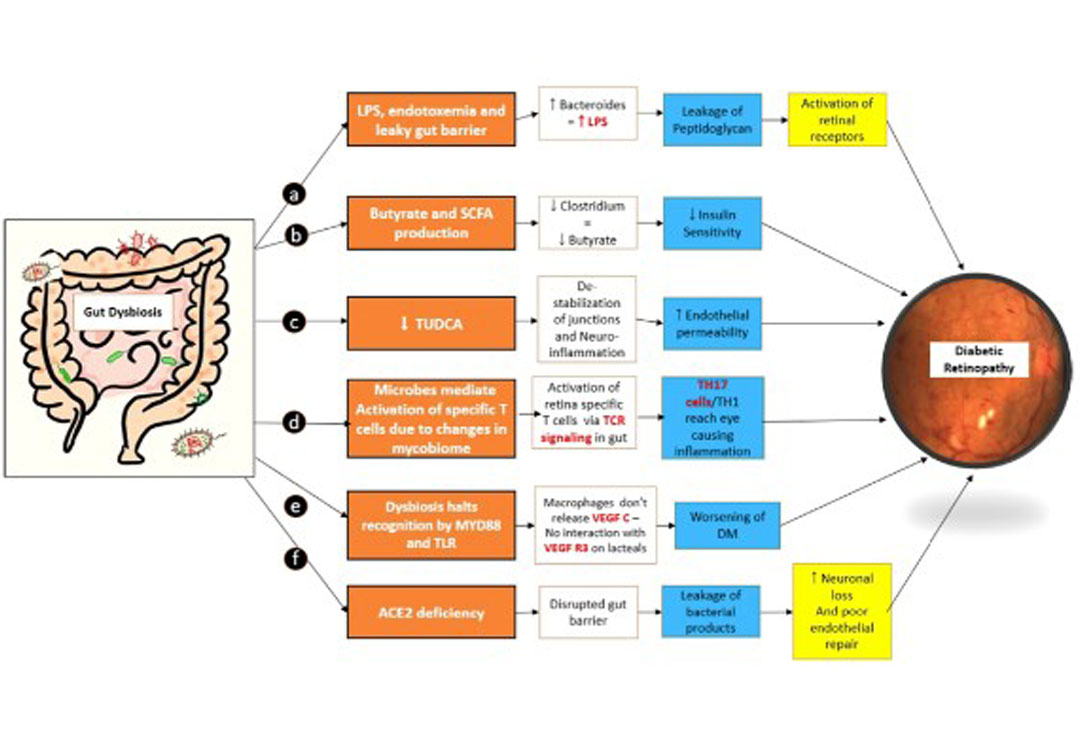
A new paper in Investigative Ophthalmology & Visual Science by Dr. Brijesh Takkar and colleagues brings together the current state of research and evidence linking gut dysbiosis with DR, presents the gaps in research, and offers research opportunities that need to be addressed at this stage. The paper primarily reports from six studies to note variation in the gut microbiome, and identifies reduced and increased abundance of various microbiota in people with DM, and DR, against healthy controls. It discusses multiple potential pathways that link dysbiosis in the gut to the retina (the gut-retina axis), including a disrupted gut barrier (due to DM) that leaks various bacterial products into the bloodstream, possibly aiding in DR progression.
The paper underscores a key nuance: the overlap among people with DM and DR, and the need for more precise longitudinal models that tease out the differences between these two overlapping groups. This information will help build predictive models that map the gut microbiome to DR progression. The paper discusses possible strategies to convert this new understanding into therapeutic interventions, ranging from intermittent fasting to new pharmacological products. It also notes the promise of supporting and altering gut flora to halt DR progression with strategies from biotic supplements to fecal transplantation. Addressing gut dysbiosis in the context of the gut-retina axis can also offer protection from worsening DM. Diet, culture, and geography—all play a confounding role in our understanding of the gut-retina axis. However, the promise of personalized therapy targeting the gut may be just around the corner.
'Noting the missing links, the group believes that our early research needs to be replicated for consistency in other ethnicities, as microbiota can be more 'ethnic' than humans. With evolution of research, therapy targeting the gut-retina axis may choose the gut, the retina, or the link between the two as the 'bull's eye',’ says Dr. Brijesh Takkar, the lead author of this paper and faculty at the L V Prasad Eye Institute.
‘This discovery is important to explain the high prevalence of diabetes in India,’ notes Dr. Taraprasad Das, Distinguished Ophthalmologist and Vice-Chair Emeritus at LVPEI. ‘It explores more efficient ways of reducing the burden of diabetes-related multi-organ (eyes, heart, kidneys, and feet) involvement in people with diabetes in India and possibly in south Asia with similar food habits and lifestyle.’
Citation
Thakur PS, Aggarwal D, Takkar B, Shivaji S, Das T. Evidence Suggesting the Role of Gut Dysbiosis in Diabetic Retinopathy. Invest Ophthalmol Vis Sci. 2022 Jul 8;63(8):21. doi: 10.1167/iovs.63.8.21. PMID: 35877085; PMCID: PMC9339698.
Photo credits : The links between gut–retina axis and its components in DR, from the paper 'Evidence Suggesting the Role of Gut Dysbiosis in Diabetic Retinopathy' by Thakur et al