
Other Refractive Errors
Last updated: 13th May 2026
Overview
All refractive errors impair our ability to see the world clearly. These are the most common forms of vision impairment in the world. They are also the most easily correctable—a simple pair of glasses/spectacles can address most forms of refractive errors. Nearly a billion people in the world are estimated to be vision impaired because they don’t have access to glasses.
Refractive errors develop when the natural shape of the eye distends or changes away from the ideal. This changed shape will mean that light will not focus exactly on the retina, leading to blurred vision. A pair of glasses will correct this distortion and re-focus the focal point back on to the retina.
What are Refractive Errors?
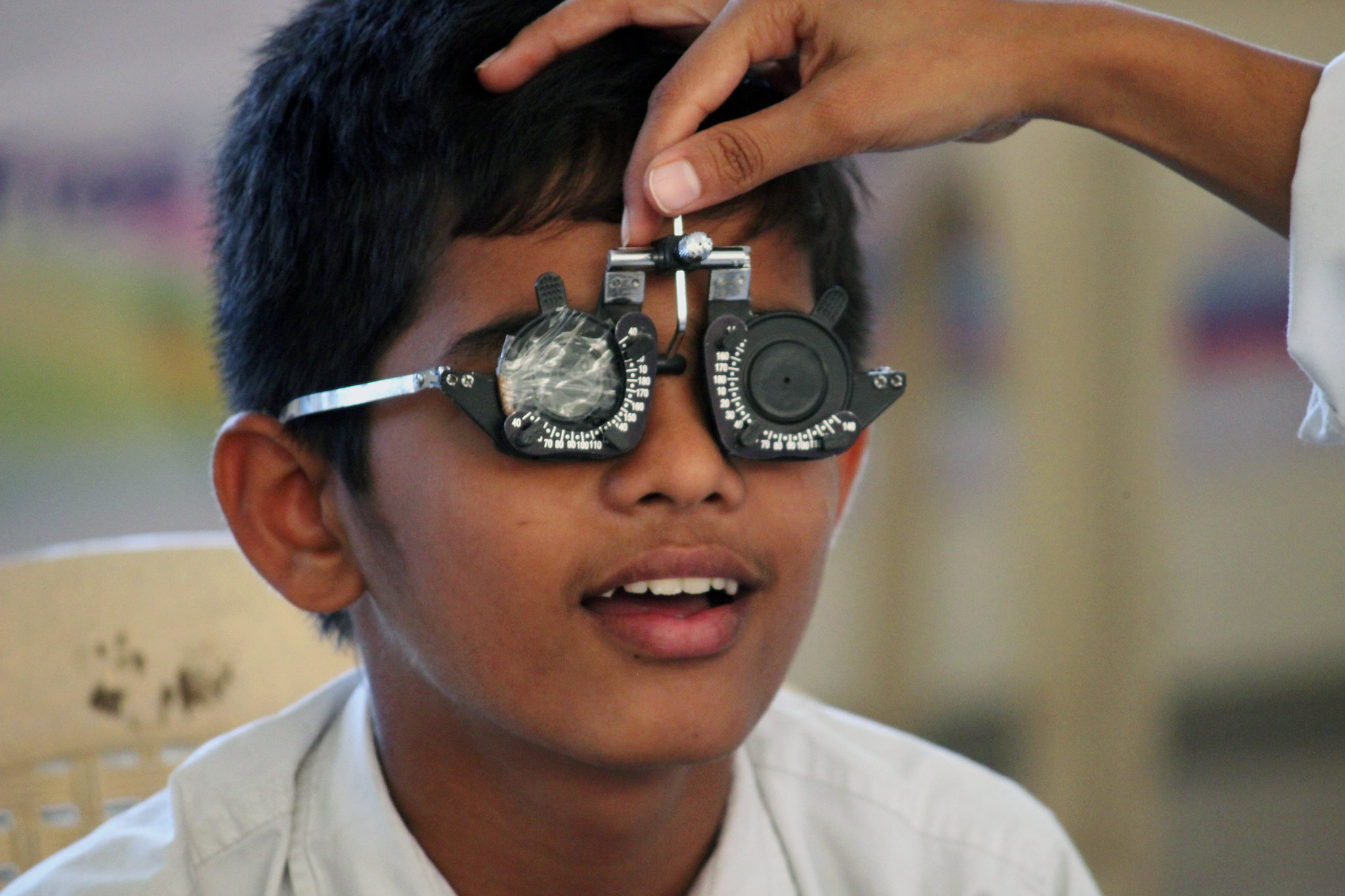
An eye that can normally bend light onto the retina is an emmetropic eye. However, different aberrations in the shape of the eye can lead to refractive errors. The most common form is myopia, or near-sightedness.
There are other types of refractive errors too.
Types of Refractive Errors
- Hyperopia
Also known as hypermetropia and far- or long-sightedness, this is a condition where the focal point of light from near objects lands ‘behind’ the retina instead of on it. Young people with hyperopia struggle to see near objects. Adults with the condition may struggle to see both near and distant objects clearly. This occurs when the eyeball is too ‘short’, or the eye’s refractive power is too weak to resolve on to the retina. - Astigmatism
The aberration here is generated by a misshapen or uneven cornea and/or lens, which generates two or more focal points on the retina. In people with astigmatism, both near and distant objects appear blurry or distorted. In many people, astigmatism appears along with myopia and hypermetropia.
Spectacles are best suited to correct the aberrations caused by this condition. - Presbyopia
A common condition among those who are 40 years and older, presbyopia is when a person struggles to resolve near objects, like text on a medicine strip, with clarity. Presbyopia is part of the ageing process, where the crystalline lens and the intraocular muscles that operate it lose their suppleness and elasticity. - Anisometropia
This is a condition where the refractive error between the two eyes of a person is significantly different. Our brain fuses image information from the two eyes into one. In people with anisometropia with glasses for correction, the brain receives two differently sized images, and the brain struggles to fuse them into one. Ultimately, it may choose to supress one eye over the other.
What are the symptoms?
Different refractive errors may have different symptoms, including:
- Hazy or blurry vision
- Glare or haloes around lamps and lights
- Squinting at distant (like a blackboard) or near objects (like a newspaper)
- Headache or strain
- Impaired depth perception
Correcting refractive errors require a balance between subjective assessment and objective measurement of power. Optometrists at LVPEI are trained to be amongst the best in the country to help you find a good fit for your needs.
Treatment options
Correcting refractive errors in most people requires a simple pair of glasses. Here are some options:
- Spectacles: Eyeglasses, an 800-year-old invention, are one of the best means for correcting refractive errors. Spectacles can hold a range of lens: from single power, to bifocal, to more complex lenses like progressive lenses or defocus lenses.
- Contact lens: Contact lenses are made of silicone hydrogel or other such oxygen permeable material and sit on the black part of our eyes. There are different kinds of contact lenses including special, large diameter scleral lenses for those with special needs. Research at LVPEI has played a key role in developing some of these lenses.
- Refractive surgery: IThere are many new high-quality surgeries to correct aberrations of the eye. These include laser eye surgery or LASIK, photorefractive keratectomy (PRK), small incision lenticule extraction (SMILE), laser subepithelial keratomileusis (LASEK) and more.
Speak to your eye doctor and find out what is best suited for your needs.
Frequently Asked Questions
There is little evidence to show that exercise or other such interventions can repair refractive errors in the eye. However, many believe they have some success with such means.
Anyone can. Young children on to adults can develop different kinds of refractive errors during their lifespan. It is best to get your eyes checked periodically.
There is some evidence that the likelihood of developing refractive errors increases if both the parents have them. It is best to get kids’ eyes checked before they begin school irrespective of such odds.
Contact lenses are safe to use. However, instructions for the care and hygiene of contact lens must be strictly followed. If not, it may lead to eye infections.
Most people who receive refractive surgery are satisfied with their outcomes, with nearly everyone receiving good quality vision. Some may develop dry eyes or light sensitivity.