The Learning Game
Written by Soujanya Padikkal
Published 30th July 2026
Srikanth Maseedupalli, Snigdha, Ruby Kala Prakasam and colleagues from L V Prasad Eye Institute explore the challenges of developing game-based learning prototypes for eye health professionals.
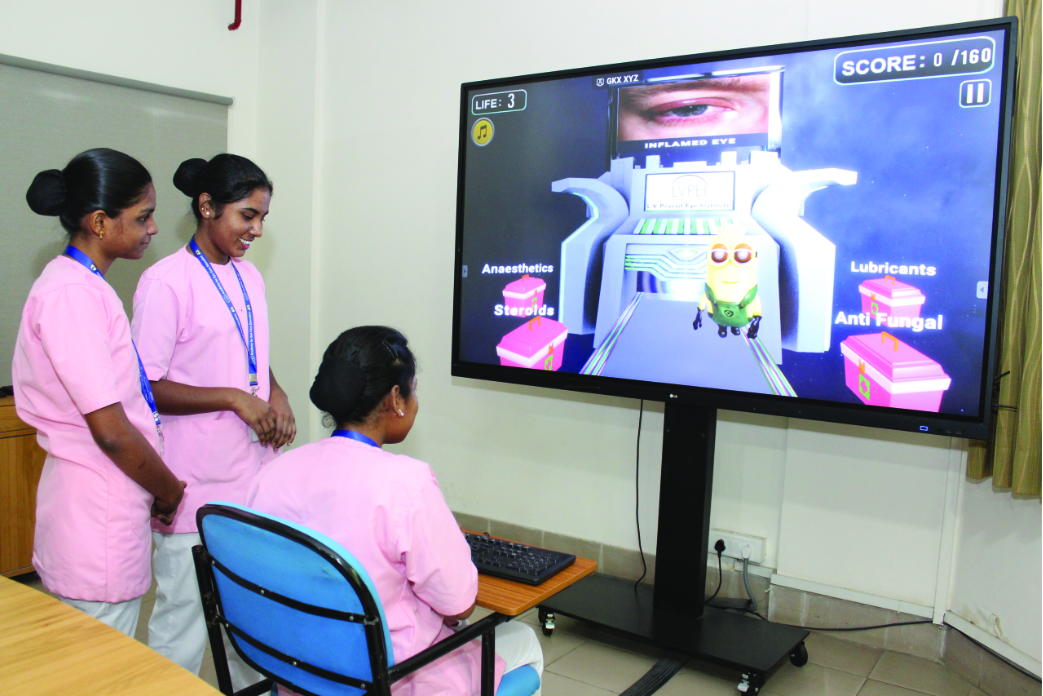
A case summary flashes on the screen. A phone rings. A nurse receives details about an incoming patient. It is followed by a video on hand hygiene and the right method to wear gown and gloves. A patient’s vital signs appear. A question pops on the screen – ‘What should be the priority focused assessment?’
These are scenes from Deteriorating Patients; a game-based learning platform used to train fourth-year medical students at McGill University. Such platforms are increasingly used to train healthcare professionals, allowing them to practise clinical decision-making in a game environment before dealing with real patients.
Game-based learning places the learner at the centre of the experience. It immerses the learner in real-world scenarios and helps them make clinical decisions while receiving immediate feedback if the diagnosis is wrong. In healthcare, game-based learning provides a safe space to hone decision-making skills before treating patients.
Game-based learning places the learner at the centre of the experience.
Such approaches have been shown to improve attention, memory, spatial abilities and learner engagement. But building a medical educational game is complex. It requires clinicians, educators and game developers to work together to translate medical knowledge into an engaging learning experience without compromising scientific accuracy. How does one build such a game and what challenges arise along the way?
In a new study published in F1000 Research, Srikanth Maseedupalli, Snigdha, Ruby Kala Prakasam and colleagues from LVPEI look at the process of developing game-based learning modules for eye health education. They conducted three focus group discussions involving ophthalmologists, optometrists, ophthalmic nurses, educators and game developers.
The discussions revolved around four phases of game development: team formation and ideation, aligning learning objectives with the cognitive skills they required, prototype development and user testing. Each phase revealed challenges which the authors eventually put into a six-point checklist covering module selection, content curation, media integration, platform choice, assessing the complexity of custom development, and resource evaluation to guide future teams developing similar educational games.
The discussions also highlighted recurring challenges, including communication gaps between clinicians and developers…
The discussions also highlighted recurring challenges, including communication gaps between clinicians and developers, balancing educational content with enjoyable gameplay, technical limitations and staff turnover during development. As digital learning takes centre stage in the education sector it becomes essential to develop tools that are informative and engaging. The authors provide a framework that could guide future game-based learning initiatives in the eye care sector.
‘This study represents a significant step in advancing game-based learning for eye health education by providing one of the first comprehensive accounts of the developmental challenges and practical solutions involved in creating educational games, offering a valuable framework for future educational innovations’, comments Dr. Ruby Kala Prakasam, Educational Research Scientist and Course Instructor at LVPEI and corresponding author of the paper.
Citation
Maseedupalli S, Snigdha S, Vaidyanathan K et al. Game-based Learning in Eye Health Education – The Developmental Challenges of E-learning Games; F1000Research 2026, 14:1390 https://doi.org/10.12688/f1000research.169156.2