
Age-related Macular Degeneration
Last updated: 13th May 2026
Overview
The macula, which is critical for fine and detailed viewing, is at the centre of the retina. With age, some people acquire a degeneration of cells in the macula leading to central vision loss. Age-related Macular Degeneration (AMD) seems to be more common in European populations, though it is found in India as well.
There is little data on the prevalence of Age-related Macular Degeneration (AMD) in the Indian population. However, LVPEI sees many patients every year, and we are a site for interesting clinical trials that are looking to address this condition.
What is Age-related Macular Degeneration (AMD)?
Age-related Macular Degeneration impacts the macula, which processes central vision on the retina. The macula is rich with cells that help us with sharp and clear vision. You are reading this text thanks to your macula. We use it to recognize faces and read detail. With age, lipid deposits (drusen) begin to appear on the macula, or blood and fluids leak into it leading to lesions and scars on it. Over time, this impairs central vision.
Age-related Macular Degeneration (AMD) may appear first in one eye and later the next. It may impact vision differently in the two eyes. The risk of AMD increases with age. More women are at risk of AMD than men.
Types of Age-related Macular Degeneration (AMD)
AMD has two types: wet and dry.
- Wet Age-related Macular Degeneration (AMD)
Also known as “exudative” AMD, this condition is characterized by the ‘oozing’ of blood and retinal fluids on to the macula from underlying tissue. A majority of the patients who came to LVPEI in the past decade for AMD treatment had wet AMD. This type is severe and leads to total vision loss. - Dry Age-related Macular Degeneration (AMD)
In this type, there is a buildup of lipid deposits called drusen across the macula. While these deposits are common with age, in AMD they are big and grow together. While less common in India, this is the dominant form in European populations.
What are the symptoms?
Age-related Macular Degeneration (AMD) is not evident to the patient until it is too late and there is substantial and irreparable vision loss. This is why periodic comprehensive eye exams are critical among those who are 45 years old and older. Some of the risk factors and signs of Age-related Macular Degeneration (AMD) are:
- Diabetes and hypertension
- A history of smoking
- A nutrient-poor diet
- Family history of AMD
- Older age
- There is some evidence that women are at more risk than men [1].
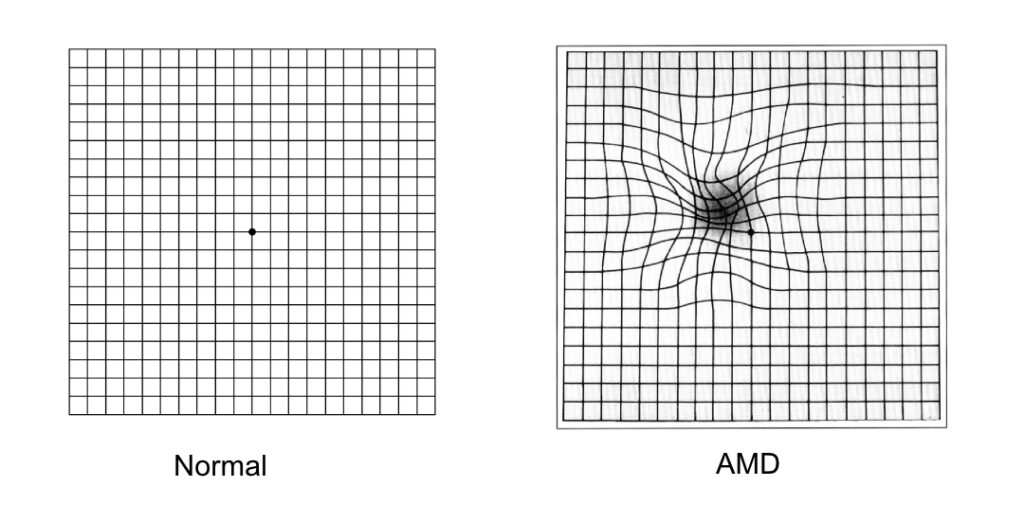
At the clinic, patients suspected of Age-related Macular Degeneration (AMD) are asked to look at the Amsler grid. Here is a representation of the distortion that may be visible for people with AMD when they look at the Amsler grid.
Treatment options
There is no cure for Age-related Macular Degeneration (AMD). Vision lost to AMD is irreparable. However, some therapy is available to arrest its progression. These include:
- Anti-VEGF medication: In Wet AMD, anti-vascular endothelial growth factor drugs can help arrest the build-up of blood vessels in the macula. These are delivered as intravitreal injections deep into the eye by trained retinal specialists.
- Clinical trials: LVPEI is a site for some promising clinical trials that are looking to arrest and reverse dry AMD.[You can read about it here.
Frequently Asked Questions
There is a high chance of losing vision to AMD. However, early diagnosis may help in arresting it or slowing down progression. Please get your eyes checked regularly if you are at risk.
Quitting smoking and eating a healthy and nutrient-rich diet can go a long way in protecting you from AMD. Regulating blood sugar levels and hypertension too will help.
All our retina specialists are trained to recognise the signs of AMD and recommend steps based on your stage or disease. The Anant Bajaj Retina Institute at LVPEI is dedicated to understanding AMD in all its complexity and offering treatment options.
Thank you for your interest. You are welcome to reach out to our Clinical Trials office and they will give you more information on any ongoing trial that you can be a part of. Please write to clinical