Cataract
Last updated: 5th May 2026
Overview
Cataract is the clouding of the eye’s focusing mechanism, the crystalline lens. Cataract is the main cause of blindness and vision loss around the world, including in India.
Nearly 66% of all vision loss in India is due to cataract. The condition is linked to ageing, and those over 60 are likely to develop cataracts. In rare instances, babies are born with congenital cataracts.
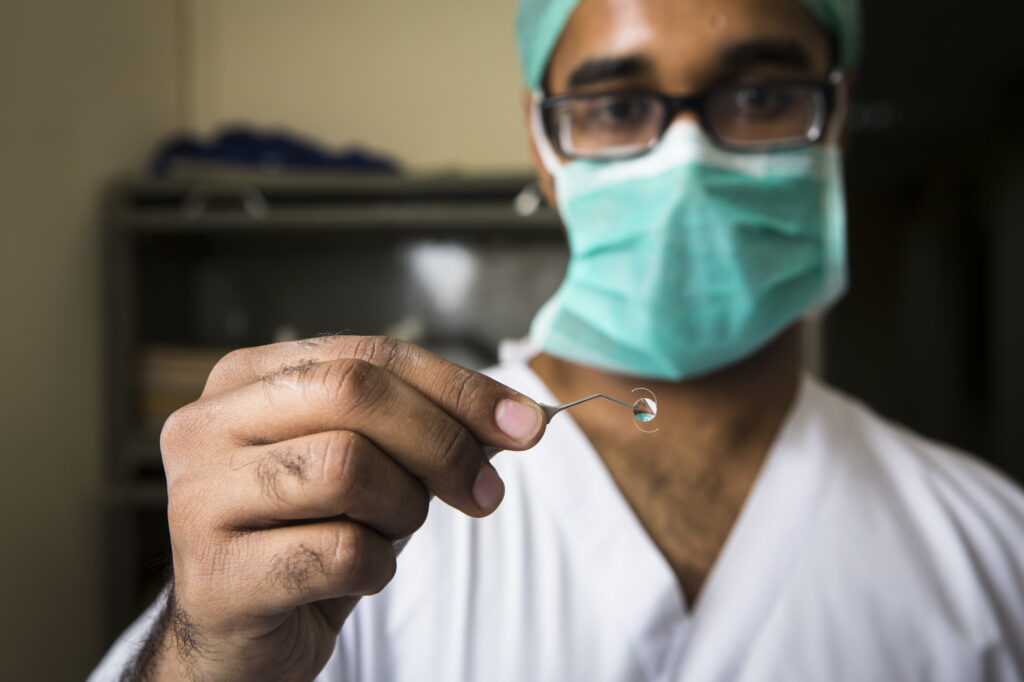
Cataracts can be addressed with a simple, low-cost surgery. The clouded lens is replaced with an intraocular lens in a 15-minute surgery restoring vision.
What is the condition?
Light enters the eye and is bent inwards to the back of the eye, the retina. The retina’s centre, the macula, is especially rich with light-sensitive cells and they help us resolve an object with clarity. The eye has a natural, transparent lens made of crystalline layers that focuses light onto the macula. The retina converts all these light rays into electrical signals for the brain, enabling vision.
This lens is situated behind the pupil (at the middle of the black part of your eye). When this crystalline lens becomes clouded, as if a thin curtain is blocking our vision, one is said to have developed cataract. Cataract is not a growth or a film over the eye.
The symptoms of cataract are progressive and cannot be corrected with glasses or contact lenses. When they start affecting daily activities, it is time to consider treatment.
What causes Cataract?
While aging is the most common cause of cataracts (due to degeneration of the proteins in the lens), other causes include:
- Health conditions such as diabetes, kidney disease, glaucoma
- Smoking
- Eye injuries, infections, or inflammation
- Prolonged use of certain medications
- Genetic or metabolic defects, particularly in children
What are the symptoms of Cataract?
Common symptoms include:
- Blurred or cloudy vision
- Difficulty seeing at night
- Sensitivity to light and glare (Difficulty driving at night or reading in dim light)
- Fading of colors
- Double vision in a single eye
- Frequent changes in glasses or contact lens prescriptions
- Colored halos
Treatment for Cataract
The only effective treatment for cataracts is surgical removal of the cloudy lens, followed by implantation of an artificial intraocular lens (IOL). Though one may still need to wear glasses for fine activity like reading or driving.
LVPEI offers:
- Advanced cataract surgery using phacoemulsification, femto-second laser, and micro-incision techniques for recovery
- Custom intraocular lenses tailored to every individual’s visual need
- State-of-the-art-technology for precision and enhanced outcome
Types of Cataract Surgeries
LVPEI offers various advanced, cutting-edge surgical techniques to treat cataract. Based on the type of cataract you have, your health condition and your lifestyle, your ophthalmologist will recommend the best suitable option for you. Here are three commonly used surgical techniques…
Small Incision Cataract Surgery (SICS)
This is a cost-effective, sutureless technique where the cataract is removed manually through a relatively larger incision (6-7 mm). This technique is used if your cataract is advanced, making other surgical options difficult.
Phacoemulsification
The most common surgery in urban hospitals. In this method a tiny instrument is inserted through a very small incision (approximately 2.2 to 2.8 mm wide). Ultrasound vibrations break the cataract into tiny pieces. These pieces are gently suctioned out.
Usually no stitches are required to close the incision. This minimally invasive surgery allows faster and safer healing, and you can return to your normal activities in no time.
Femtosecond Laser Cataract Surgery
The Femtosecond laser is the latest breakthrough in advanced cataract surgery. It is blameless using lasers for high precision incisions and safety.
The lasers help with surgical incisions and precise centring of the intraocular lens.
The additional advantage of this laser is that it is accurate enough to plan incisions in the peripheral cornea to aid in the correction of pre-existing corneal astigmatism (cylindrical power).
What are the various lens options available at LVPEI?
Intra Ocular Lens (IOL) Options for cataract surgery Monofocal Lens
Monofocal IOL is the basic type of lens implanted after cataract surgery. It is designed to provide clear, distance vision. However, one will need glasses for reading and close, detailed work. There are various materials that monofocal lens is available in.
Toric Monofocal Lens
It is used to correct corneal astigmatism. Corrects vision for distance and cylindrical power (if any) and will require glasses for near and intermediate work.
Aspheric Lens
Most lenses have a spherical surface, which can induce aberrations in vision. Aspheric optics ensure better quality vision and enhance contrast sensitivity. It also allows better night vision and visibility under low light conditions.
Multifocal Lens
It is designed to help to see clearly at near, intermediate and far distance, and reduces the dependency on glasses. One may occasionally require spectacles or glasses for fine tasks at near distance.
Multifocal Toric Lens
This lens corrects cataract and astigmatism, providing clear vision for near, intermediate and far distances and reduces the dependency on glasses. One may occasionally require spectacles/glasses for fine task at near and distance.
Frequently Asked Questions
Cataract surgery is a safe and predictable procedure that can be performed whenever reduced vision starts to impact day-to-day life. Thanks to development in technology, people no longer need to wait for cataracts to fully develop as criteria for surgery.
If left untreated, the clouded areas of the lens can become larger and denser, worsening vision, taking anywhere between a few months to many years. Eventually the entire lens can become clouded, leading to further increase in blurred vision, thus affecting daily activities.
No single lens works for everyone. The ophthalmologist will be able to determine the most appropriate option for a patient. However, in general if one would like to depend less on glasses, ask your eye specialist about LVPEI’s range of multifocal lenses.
Once cataract is removed it cannot recur. However, over time, some patients may complain of cloudy vision. This condition is called secondary cataract and can be treated by a simple laser procedure.
The overall success rate of cataract surgery is +98%. Continuous innovation in techniques and instruments has made the procedure simpler and safer than ever before.
Phacoemulsification is a good technique and has the following benefits – micro incision, stitch less, safe and fast visual recovery.
A minimum of seven days’ rest is recommended before one resumes their day-to-day activities. This may vary based on eye conditions and working environments. Polluted and stressful environments should be avoided.
In most cases, a small refractive error is present after cataract surgery and wearing glasses will provide sharper vision
Yes. The surgeon will offer medication to help relax and ensure steps to avoid any pain to the patient.
The surgical procedure typically lasts between 15 and 30 minutes, although it takes around two to three hours for the entire process. This also includes the time taken to prepare for and after the surgery.
The cost of cataract surgery can vary depending on several factors, including:
- Type of intraocular lens (IOL) you want to select
- The technology involved in the procedure
For more details, please visit our institute or call us on 040-30612140 or email us at cataract@lvpei.org
As the eyes heal, following surgery, one may experience various visual disturbances, such as glare and halos (rings around light sources) in certain lighting conditions. This is normal and usually subsides over time.
Most people notice a significant improvement in their vision and can resume everyday activities within 24 hours after cataract surgery, keeping in mind the precautions that are informed after surgery. However, depending on which intraocular lens was implanted, recovery can take between two weeks to six months to completely adjust and to achieve your optimal vision.
How does the Eye work?
Vision begins when light enters the eye. Each part of the eye plays an important role in focusing this light and sending visual signals to the brain.
- Cornea: The clear, outer layer that helps focus light into the eye
- Pupil: The opening that allows light to enter
- Iris: The colored part that controls the size of the pupil
- Lens: Bends and focuses light onto the retina
- Retina: A layer of light-sensitive tissue that converts light into signals sent to the brain
- Vitreous Gel: The clear gel that fills the eye and maintains its shape
Clear, well-functioning eye parts are essential for sharp vision. Any damage or disease affecting them can impair sight.