Breaking the Anchor
Written by Soujanya Padikkal
Published 26th June 2026 / Last updated 3rd July 2026
Gowtham Lakshminarayanan, Sanhita Roy along with colleagues from LV Prasad Eye Institute explore the antifungal potential of Manogepix for treating fungal keratitis cases.
It is 2006. Bausch and Lomb, a Fortune 500 manufacturer of contact lens and care solutions, suspended its production of contact lens solution following reports of fungal outbreaks among contact lens wearers in Hong Kong, Singapore, and the United States. The outbreak was traced to Fusarium, a filamentous fungus and one of the causes of fungal keratitis (FK).
FK is a sight-threatening infection affecting the cornea, the clear outer membrane of the eye. It accounts for up to 60% of infectious keratitis cases in India, however here it primarily affects agricultural workers, whose eyes are often injured by leaves, twigs or other organic matter carrying fungal spores. Delayed diagnosis, limited treatment options and poor outcomes continue to make it one of the most difficult corneal infections to treat.
And despite its severity, treatment options have changed little over the years, in both developed and developing world contexts. Natamycin is the only FDA-approved ophthalmic antifungal eye drops, for example. It is therefore crucial to explore alternatives that can tackle fungal infections.
Despite its severity, treatment options have changed little over the years, with natamycin remaining the only approved topical antifungal drug
One option that researchers are exploring is manogepix (MGX), the active form of the experimental prodrug fosmanogepix. Fungi depend on cell-surface proteins for key functions including maintaining their structural stability. These proteins are transported from within the cell and attached to the cell wall through molecular anchors.
MGX targets Gwt1, an enzyme that helps build these anchors; inhibiting it compromises fungal growth and survival. Gwt1 is absent in humans and hence the drug is expected to target only the fungal cell wall leaving the host cells unharmed.
Fosmanogepix is currently in phase three clinical trials for the treatment of fungal infections of the blood, internal organs, or invasive mold diseases like mucormycosis. Could its active form also work against fungal eye infections?
In a new study published in Investigative Ophthalmology and Visual Science, Gowtham Laxminarayanan and colleagues from LVPEI tested MGX against predominant ocular fungal pathogens such as, Candia albicans, Fusarium solani and Aspergillus flavus isolated from patients with corneal fungal infections.
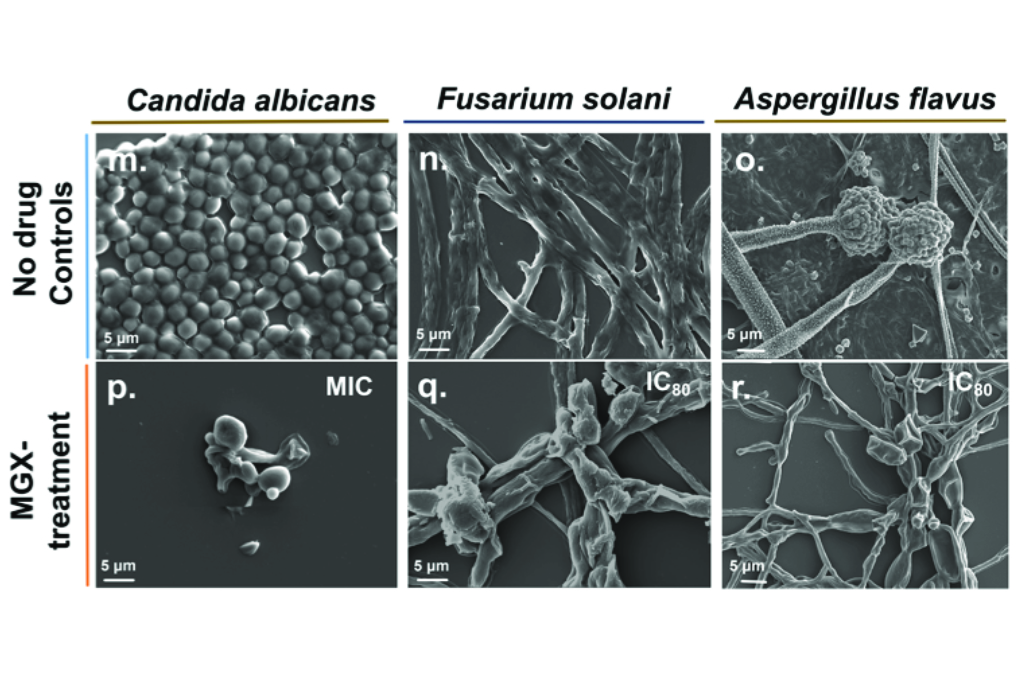
In lab settings, the drug killed C. albicans at very low concentrations and suppressed the growth of both Fusarium and Aspergillus. Scanning electron microscopy revealed collapsed cell wall and fragmented fungal structures after treatment. It also inhibited biofilm formation, preventing the fungus from forming protective colonies which contribute to its resistance against drugs.
MGX targets Gwt1, an enzyme that helps build molecular anchors. Inhibiting it compromises fungal growth and survival.
MGX was found to be safe in cultured human corneal epithelial cells at concentrations effective against the fungi, although the authors note that longer exposure may affect the integrity of the corneal surface. When tested in a rabbit model, it was noted that topical MGX reduced inflammation and fungal burden to levels comparable with amphotericin B, a commonly used antifungal drug in the eye.
The researchers also observed additive effects when MGX was combined with amphotericin B, meaning the two drugs worked better together than on their own. Fosmanogepix is already in advanced clinical development for systemic fungal infections. While further studies are needed, MGX shows promise as a treatment for fungal keratitis of the eye.
“Every meal reminded me of the farmers who feed us. Knowing that fungal keratitis threatens their vision and livelihood inspired me to work toward better treatments for this neglected disease,” remarks Gowtham Lakshminarayanan, Research Scientist at LVPEI.
Citation
Gowtham L, Meghana Y, Mannangatty T, Vasavi S, Nirmal J, Bagga B, Garg P, Mishra DK, Roy S. Novel Inositol Acyltransferase (Gwt1) Inhibitor for Fungal Keratitis Treatment: Evaluation of In Vitro and In Vivo Efficacy and Safety. Invest Ophthalmol Vis Sci. 2026 Apr 1;67(4):49. doi: 10.1167/iovs.67.4.49. PMID: 42012271; PMCID: PMC13104782.
Photo credit: Excerpted from Fig 4.; Gowtham et al.