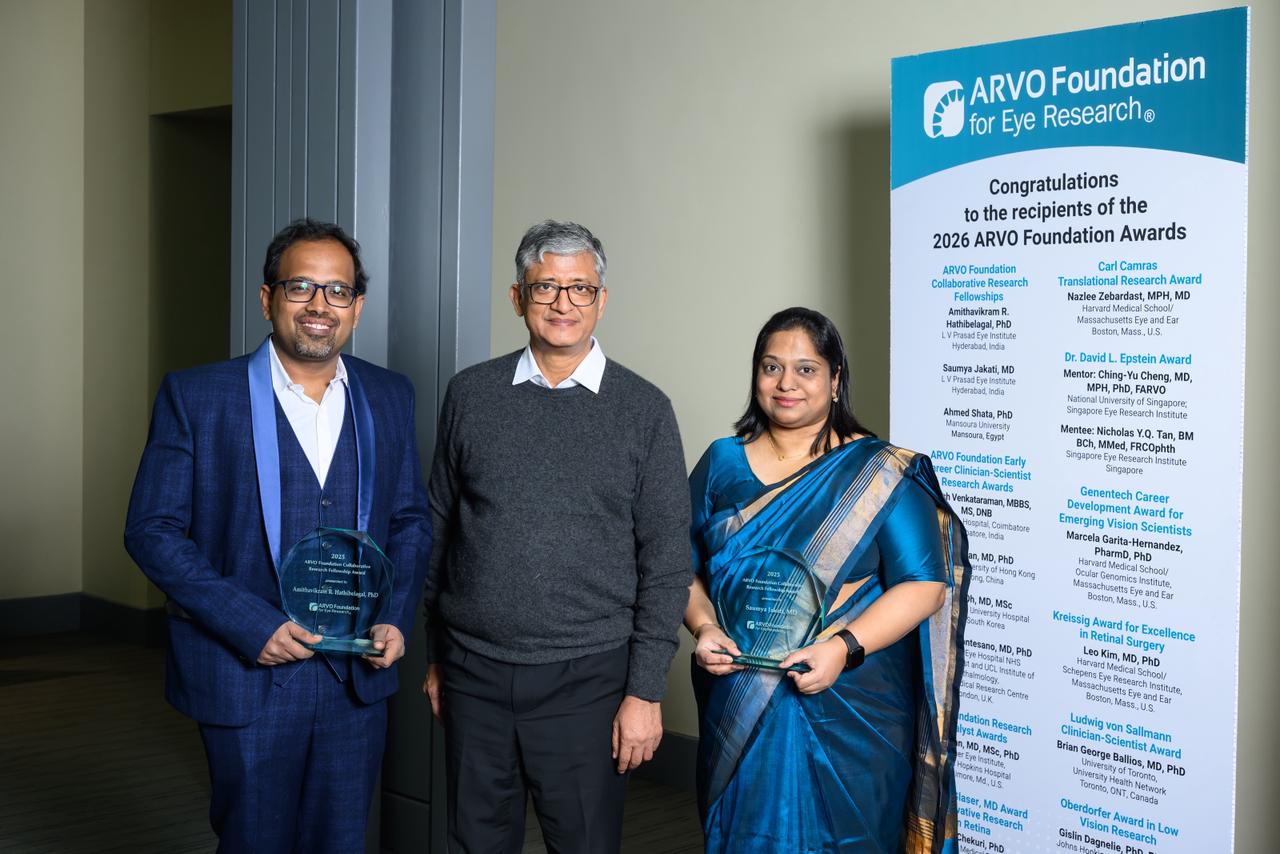
LVPEI wins Second Prize at the International Biobank Conference (IBC) 2026



Written by Tejah Balantrapu
Published 15th July 2026 / Last updated 25th July 2026
Ophthalmic genetic research is at the cutting-edge of genomic studies, and is helping us understand human genetic inheritance, including pathologies and diseases, better. A new generation of tools and technologies, along with molecular studies, are transforming precision medicine and improving our ability to explore health care innovation and sight restoration.
An editorial in the latest issue of IOVS (Investigative Ophthalmology and Visual Sciences) outlines best practices for genetic studies to keep pace with the rapid advancements in multiomics, next-generation sequencing, and gene-editing technologies. These guidelines, by a special committee of IOVS Editors led by Dr. Subhabrata Chakrabarti, recommends stricter statistical power, biological validation, and a standardized approach to diversity.
The new guidelines assert that:
…self-identified race and ethnicity should not be used as proxies for genetic ancestry groups or to represent the genetic diversity of study participants and are not recommended for use as analytic variables.
Instead, the ancestry of the study participants must be genetically ascertained. Accurate ancestry becomes important especially when cases are compared to controls, to guard against any hidden population structures.
Emphasising methodological transparency, whole-genome sequencing (WGS), whole-exome sequencing (WES), or deep sequencing studies are expected to clearly list their quality control measures, algorithms, and software pipelines. They must have adequate sample sizes, and ideally, should be replicable in an independent population. All observed variants must be scored against the revised ACMG/ClinGen guidelines. Additionally, these studies are expected to demonstrate the actual biological impact or altered function of the implicated variant using in vitro or in vivo platforms.
The guidelines prioritise novel ocular phenotypes in genome-wide association studies (GWAS). They mandate clear confounder controls, accounting for population stratification, genetic relatedness, and specific covariates. They also emphasise publicly available summaries and meta-data submission to popular public repositories like the GWAS catalog. Polygenic risk scores that are drawn from well-powered GWAS are encouraged, especially when benchmarked against existing scores.
Studies that have discovered new mutations are now encouraged to look beyond ‘case reports’ to functional insights into the disease mechanism or clear epidemiological data. In addition, Indian researchers should take note:
well-powered genetic association studies in previously uncharacterized “ancestral” populations that provide new insight will also be considered.
The guidelines mandate that all variants must strictly adhere to Human Genome Variation Society (HGVS) nomenclature and ACMG pathogenicity rules.
As studies increasingly look at global datasets (transcriptomics, proteomics, and metabolomics), the guidelines introduce guardrails: defining clear statistical thresholds for extracting data points from large omics databases; quantifying yields—and ruling out acquired mutations—from primary cell cultures (and other specimens); and strict assessments to rule out off-target genetic effects in gene editing tools like CRISPR.