Sairam Abbireddy, Joveeta Joseph, Bhupesh Bagga and Sachin Shukla from LV Prasad Eye Institute investigate the therapeutic potential of mesenchymal stem cells to treat bacterial keratitis.
Bacterial keratitis is a sight-threatening bacterial infection of the cornea, the transparent outer layer of the eye. Staphylococcus aureus and Pseudomonas aeruginosa are among the leading microbial causes of this infection. The standard treatment is antibiotic eye drops such as ciprofloxacin because they are effective, affordable, and widely available.
But as antimicrobial resistance rises, such bacterial infections stop responding to broad-spectrum antibiotics. Researchers are therefore exploring new ways to combat bacteria that no longer respond to standard treatment. One such approach has led them to look for solutions within the human body itself.
As antimicrobial resistance continues to rise, the answers may lie within the human body itself–at least for eye infections.
Mesenchymal stem/stromal cells (MSCs) are self-renewing cells found in different tissues of the body and play a role in regulating inflammation and immune responses. They do this by exuding a range of proteins, growth factors, and signaling molecules into their surroundings. This ‘cocktail’ of bioactive molecules is collectively known as the ‘secretome’.
Among its many molecules are antimicrobial peptides (AMPs) – naturally occurring proteins capable of disrupting bacterial cell membranes and inhibiting biofilm formation (an agglutinate of microorganisms that cluster together). When MSCs are grown in the laboratory in a nutrient-rich liquid lacking serum and antibiotics (the medium), their molecular cocktail specifically accumulates in the medium. It is then collected and filtered out, and the resulting cell-free liquid is known as ‘MSC-conditioned medium’ (MSC-CM).
Previous studies have pointed to the therapeutic effects of conditioned medium for microbial infections. Could this cocktail help fight bacterial keratitis?
Among the molecules secreted by MSCs are antimicrobial peptides capable of disrupting bacterial membranes and inhibiting biofilm formation.
In a new study published in Infection and Immunity Sairam Abbireddy (a postgraduate student), Joveeta Joseph, Bhupesh Bagga, and Sachin Shukla from LVPEI explore this possibility. They collected conditioned medium from MSCs derived from adipose tissue (body fat), bone marrow, dental pulp, and umbilical cord. The MSCs were procured through commercial and collaborative resources.
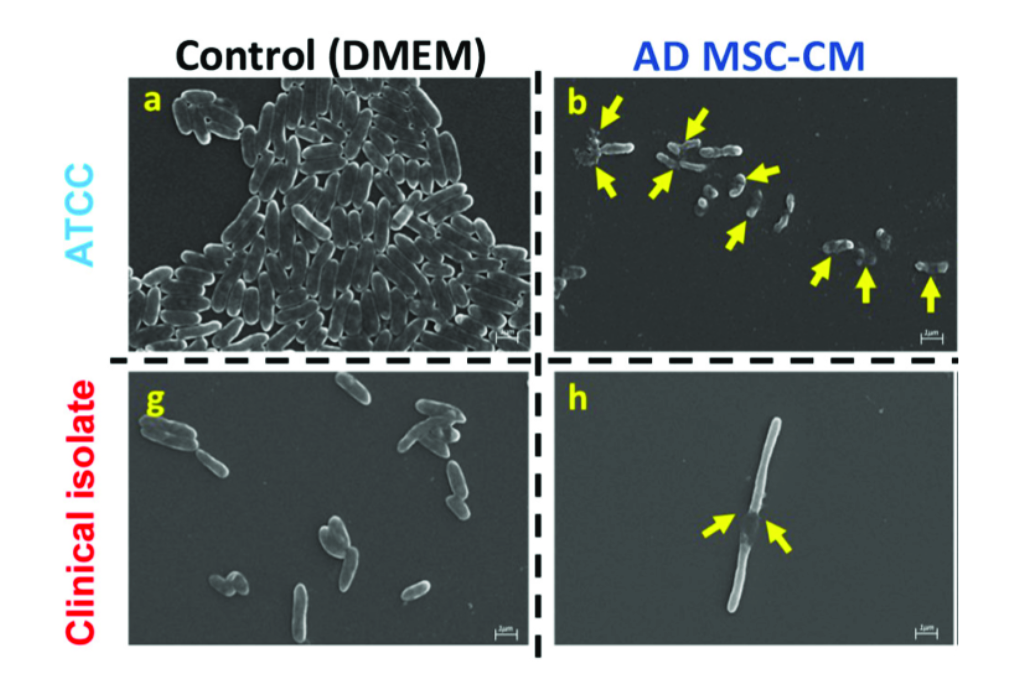
They tested it against laboratory strains and patient derived samples (clinical isolates) of both S. aureus and P. aeruginosa and compared the outcomes with ciprofloxacin antibiotic. It was noted that MSC-CM inhibited the growth of both pathogens with adipose tissue derived medium, showing the strongest antibacterial activity.
Scanning electron microscopy revealed a ruptured bacterial membrane after treatment, a sign of AMP activity. Of the peptides detected in the medium, Human Beta Defensin-3 and Dermcidin were present in high concentrations, though their levels varied depending on the source of MSC.
The antibacterial activity came not from the stem cells themselves, but from the molecules they secreted
Interestingly, a dual effect was also observed. When the conditioned medium was applied to cultured human corneal epithelial cells that were exposed to bacterial toxins, the cells produced higher levels of AMPs while inflammatory signals known to damage the corneal membrane were suppressed. This is something conventional antibiotics do not do.
The team then tested the MSC-CM on donor corneas which were infected with a clinical isolate. It reduced bacterial burden comparable to ciprofloxacin while preserving corneal transparency better. The findings are significant because the antibacterial activity came not from the stem cells themselves, but from the molecules they secreted, and the tissue source influenced AMP activity.
This, as a potential cell-free therapy, is expected to minimize the cell-induced alterations and side-effects, subject to the success of pre-clinical and clinical studies in near future. As antimicrobial resistance continues to rise, the answers may lie within the human body itself–at least for eye infections.
“This study highlights the antibacterial properties of mesenchymal stem cell-derived conditioned medium against bacteria causing ocular infections”, notes Dr. Sachin Shukla, Research Scientist at LVPEI. “This, in combination with the widely studied immunomodulatory properties of mesenchymal stem cells, underlines its therapeutic potential for bacterial keratitis, particularly in the context of rising antibacterial resistance.”
Citation
Abbireddy S, Joseph J, Bagga B, Shukla S.2026.Mesenchymal stem cell-derived conditioned medium demonstrates novel antibacterial effects in ocular bacterial infections. Infect Immun94:e00697-25.https://doi.org/10.1128/iai.00697-25
Photo credit: Excerpted from Fig 1; Abbireddy et al