Treating Eye Moles with Light
Written by Soujanya Padikkal
Published 26th June 2026
Anasua Ganguly Kapoor and colleagues from LVPEI provide the proof-of-concept to treat deep conjunctival nevi using yellow laser photocoagulation.
On a sleepless, wintry night in 1946, as twenty-five-year-old Gerhard M. Schwickerath tossed and turned, he held onto two words lest he forgets them - ‘light’ and ‘coagulation’. He was consumed by the idea of applying photocoagulation (the process of using light to generate heat and surgically destroy tissue) to treat eye conditions that night. His idea would eventually give rise to laser photocoagulation, where a focused beam of light, of a specific wavelength, would transfer its energy into a target tissue.
The absorbed light quickly converts to heat, which damages the targeted cells while minimizing injury to the surrounding cells. Developed in the early 2000s, the yellow-light laser at 577nm wavelength has become a preferred choice for retinal lesions because of its compact size, energy efficiency, longer lifespan and the ability to target the tissue with minimal damage. Could the same principle be used to treat tissues on the eye’s surface?
The absorbed light quickly converts to heat, which damages the targeted cells while minimizing injury to the surrounding cells
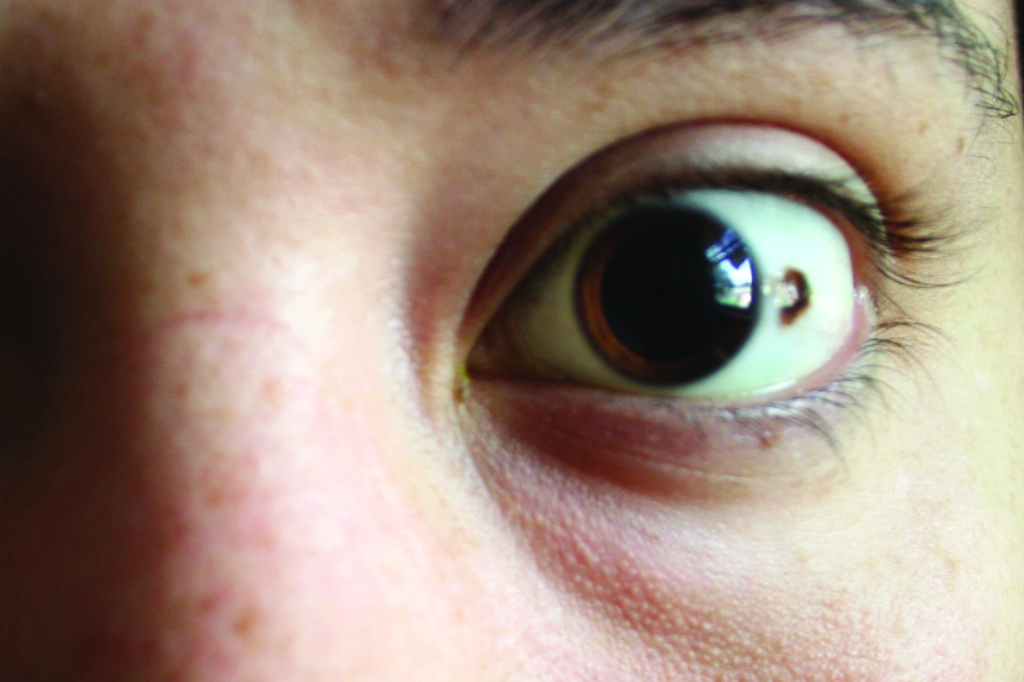
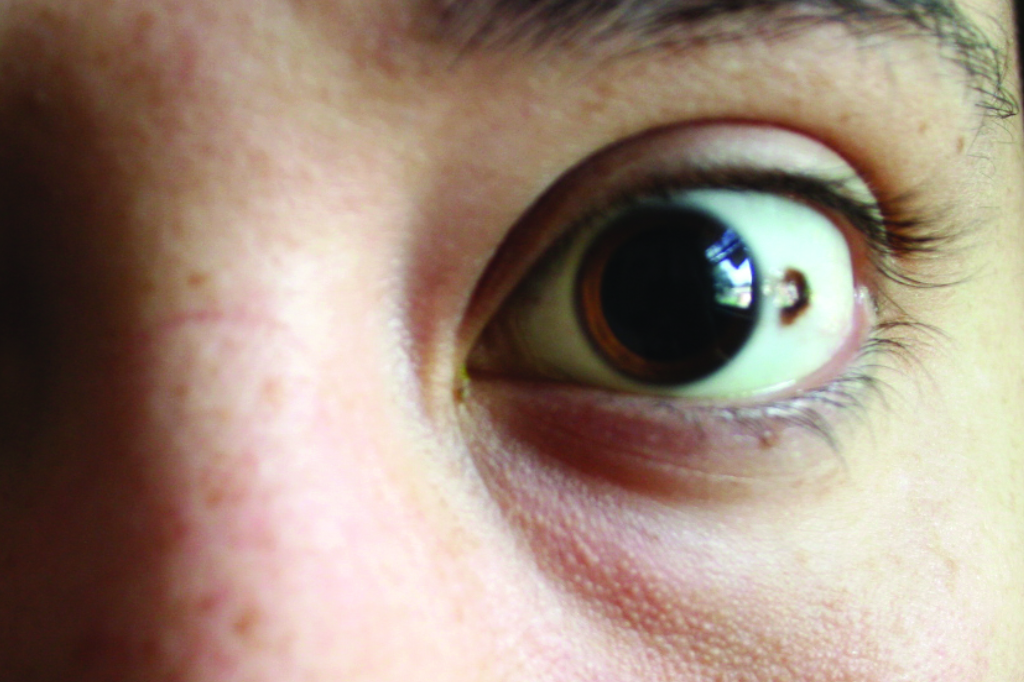
Conjunctival nevi are mole-like pigmented spots on the conjunctiva, the clear membrane covering your eyeball. A nevus is harmless. Like moles on the skin, they need to be monitored regularly as they carry a small risk (less than 1%) of developing into a cancer. Some may choose to get rid of them for cosmetic reasons. Treatment involves surgical excision, which is reserved for suspicious lesions which show signs of growth or cosmetic concerns.
But surgical removal comes with its own risks: being expensive, need for an operation theatre set up, need for anaesthesia, complications like scarring, abnormal new blood vessel growth and so on. It also demands a skilled surgeon to dissect the lesion while preventing damage to adjacent tissues like the cornea and the layers beneath the conjunctiva thereby minimizing irregular healing.
Clinicians therefore have been looking for a less invasive procedure.
In a new study published in the European Journal of Ophthalmology Anasua Ganguly Kapoor and colleagues from LVPEI explored treating deep conjunctival nevi using yellow laser photocoagulation – the first study to do so. Ten eyes from nine patients were included in this study with an equal male to female ratio (1:1). All cases involved deeply pigmented, subepithelial nevi, the type which was excluded from existing studies in literature.
The patients were treated under topical (eyedrop) anesthesia and then exposed to yellow laser in short 80 millisecond pulses with power adjusted depending on the degree of pigmentation. During treatment the nevus first turned grey, then developed tiny cavitation bubbles before charring – a sign that treatment was complete. The charred tissue was removed using a cotton bud.
The findings indicate that yellow light photocoagulation is a safe and effective minimally invasive procedure with no known side effects for mole-removal on the eye.
All ten eyes showed complete removal of nevi. The authors observed mild conjunctival scarring in one patient when the laser reached the underlying tissue. There were no recurrences observed during follow-up. The findings indicate that yellow light photocoagulation is a safe and effective minimally invasive procedure with no known side effects for mole-removal on the eye.
“Yellow laser photocoagulation represents a paradigm shift in the management of conjunctival nevus, offering a minimally invasive, OPD-based, and cost-effective alternative to surgical excision, and is the first reported use of yellow laser for the treatment of conjunctival nevus in the literature’, remarks Dr. Anasua Ganguly Kapoor, Consultant Ophthalmologist at LVPEI and corresponding author of the study.”
Citation
Kapoor AG, Molugu S, Jakati S, Kate A. Yellow Laser Photocoagulation of Deep Conjunctival Nevus: A Minimally Invasive Technique. European Journal of Ophthalmology. 2026;0(0). doi:10.1177/11206721261438649
Photo credit: Lindsey Turner; Nevus: CC BY 2.0