CVI: Assessment to Intervention
Written by Soujanya Padikkal
Published 24th September 2026 / Last updated 25th September 2026
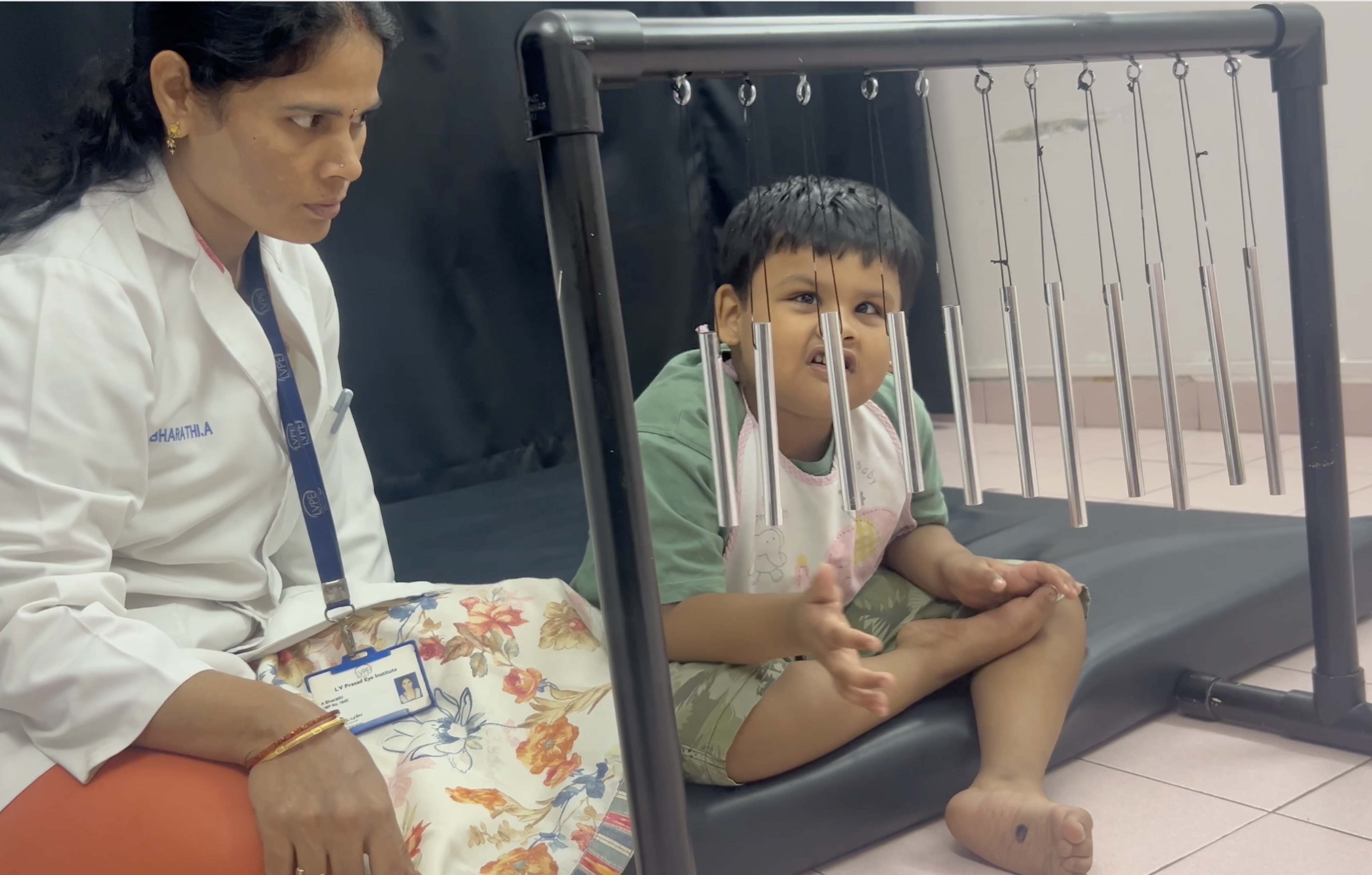
Beula Christy, Ramesh Kekunnaya and colleagues from the LV Prasad Eye Institute develop a framework to help guide doctors and families in assessing and supporting children with cerebral visual impairment.
Before picking a restaurant, Nicola McDowell, a senior lecturer at Massey University, New Zealand worries about it being well-lit. Will she be able to amble past the chairs and tables to where she will sit? She worries that if someone calls out to her, she may have trouble figuring out where they are. Nicola has good visual acuity, but stress can make it difficult for her to recognize people. “They all end up looking the same”, she explains in a video, ‘My CVI Journey’. Her challenges went undefined for the first 16 years of her life, until she was diagnosed with cerebral visual impairment (CVI) in 2013.
CVI occurs when damage to the brain’s visual pathways and processing areas affects a person’s ability to process visual information. It is common in infants and young children and can continue into adulthood. A child with CVI may have difficulty recognizing a familiar face in a crowd, finding an object in a cluttered space or processing visual information quickly.
A conventional eye exam may not capture the difficulties the child is experiencing, as this assessment will need more than measuring visual acuity. There are also chances of misdiagnosis as some symptoms of CVI overlap with other conditions like autism or ADHS. Apart from visual acuity and function, clinicians need to consider how the child uses vision to navigate everyday tasks. As Nicola puts it, they need to understand “what it is like to live each day with a different normal”.
So, how can clinicians diagnose and support a child with CVI, especially in India where such awareness is even rarer?
Apart from visual acuity and function, clinicians need to consider how a child uses vision to navigate everyday tasks.
In a new study published in the Indian Journal of Ophthalmology, Beula Christy and colleagues from LVPEI developed practice-oriented guidelines for clinical and functional assessment, and rehabilitation of children with CVI. The guidelines draw on existing literature, global test practices, clinical experience, and professional consensus covering three areas: clinical assessment, functional vision assessment, and intervention.
The resulting framework is intended to guide ophthalmologists, optometrists, therapists, rehabilitation specialists, teachers, and families. The authors also point towards the importance of collecting information from parents about the child’s behaviour as no two children with CVI are the same. This is why the framework emphasizes that there is no single approach that works for every child with CVI and that care needs to be personalized.
The authors suggest a structured protocol, early diagnosis, coordinated care, spreading awareness, and care, spreading awareness, and integrating guidelines into policy and practice as few measures to help children with CVI.
The researchers suggest individual interventions focused on strengthening visual skills, personalized adaptations like changing the child’s environment by minimizing visual clutter and sensory distractions, adjusting lighting, and using high-contrast materials along with assistive technology. The authors suggest a structured protocol, early diagnosis, coordinated care, spreading awareness, and integrating guidelines into policy and practice as few measures to help children with CVI.
‘Diagnosis and management of CVI can be challenging. This study is an attempt to educate and provide guidelines to professionals and caretakers, on assessing and supporting a child with CVI’, says Beula Christy, Head, Institute for Vision Rehabilitation, LVPEI and first author of the study.
Citation
Christy B, Ampolu N, Jayaraman D, Kekunnaya R, Mahalakshmi M, Sankar S, Sumalini R, Warkad V, Majhi D, Manohar V. Cortical/cerebral visual impairment: Assessment to intervention. Indian J Ophthalmol. 2026 Aug 1;74(8):1109-1114. doi: 10.4103/IJO.IJO_1014_25. Epub 2026 Jul 31. PMID: 42535804; PMCID: PMC13485087.
Photo credit: Vinay Kumar Tangellapalli