Tear Film Microbiota in MGD
Written by Soujanya Padikkal
Published 29th October 2026
Anupama Hela, Pragnya Rao, Swati Singh, Sayan Basu and K. Arunasri from the LV Prasad Eye Institute report changes in tear-film bacteria and in meibum lipids in people with meibomian gland dysfunction.
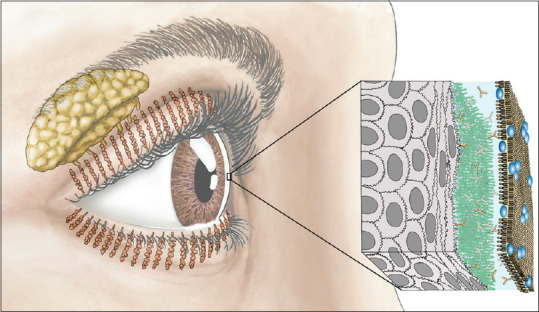
Every time we blink, a thin film of tears spreads across the surface of the eye, protecting it. This tear film is made of three layers that help maintain a healthy ocular surface. An inner mucous layer spreads the tears across the eye, while the bulk is water (and some proteins and antibodies). The outermost layer is formed by meibum, an oily substance produced by glands in the eyelids called the meibomian glands.
Meibum helps stabilize the tear film and reduce evaporation. When these glands become blocked or their secretions are altered, it leads to a condition called meibomian gland dysfunction, where tears evaporate quickly—sooner than normal. MGD leaves the eye dry and irritated and is a form of Dry Eye Disease.Meibum is believed to have antimicrobial properties, so changes in its discharge may affect the bacteria that live on the eye’s surface.
These bacteria are part of a community of microorganisms, the ocular microbiome, most of which are harmless. Some bacteria can form biofilms – aggregates of microorganisms that stick together in a protective matrix that helps them thrive–while other bacteria produce enzymes that break down lipids affecting the meibum layer.
Meibum is believed to have antimicrobial properties, so changes in its discharge may affect the bacteria that live on the eye’s surface.
Meibum itself is made of different kinds of lipids: non-polar lipids make up most of the oily layer and help reduce evaporation, while polar lipids interact with the watery tear layer. Any imbalance could promote the growth of pathogenic bacteria. So, a dysfunction in meibum secretion seems to be setting up a lot of changes on the eye’s surface: altered lipid profiles which exacerbate MGD, and a surge of disease-causing bacteria.
However, do all these changes add up to a disease profile that is reliably different from a healthy eye?
In a new study published in Experimental Eye Research, Anupama Hela and researchers from LVPEI examined tear-film bacteria and meibum lipids in 20 people with MGD and 24 healthy controls. They grew bacteria from tear samples, identified them by sequencing a gene (16S rRNA) and tested whether each isolate could form a biofilm. In a subset of participants (12 with MGD and 8 controls), they analyzed meibum using a technique called liquid chromatography mass spectrometry, which separates and identifies molecules by their mass. The team then examined correlations between lipid profiles, bacterial characteristics, and ocular surface associated clinical measures like-film stability.
The lipid analysis showed a shift towards more polar lipids and fewer non-polar lipids, which may affect how meibum spreads and maintains tear-film stability.
The researchers identified 28 bacterial species in patients with MGD compared with 12 species seen in controls, indicating higher bacterial species richness in MGD, despite lower bacterial load. Gram-negative bacteria were mostly seen in MGD isolates compared to controls. Among the isolates from people with MGD, 97% formed biofilms compared with 48% from healthy controls.
The lipid analysis showed a shift towards more polar lipids and fewer non-polar lipids, which may affect how meibum spreads and maintains tear-film stability. Biofilm-forming bacteria were positively associated with the proportion of polar lipids implying change in lipid composition could impact bacterial growth. What remains unclear is if the altered lipid composition drove a change in the bacterial population or vice-versa.
‘This study provides plausible association between increased polar lipids and biofilm-forming bacteria which highlights a potential interplay between lipid homeostasis and microbial colonization’, says Dr. K Arunasri, Research Scientist, LVPEI and corresponding author of the paper. ‘The findings also highlight the underlying ocular surface microbiome dysbiosis and tear film instability in MGD patients’.
Citation
Hela A, Donthineni PR, Singh S, Basu S, Arunasri K. Tear film Microbiota in Meibomian gland dysfunction: Compositional changes and their correlation with meibum lipids and tear film parameters. Exp Eye Res. 2026 Nov;272:111212. doi: 10.1016/j.exer.2026.111212. Epub 2026 Aug 22. PMID: 42628828.
Photo credit: Figure 1, Paulsen et al