Retinal Disease and Policy
Written by Soujanya Padikkal
Published 27th May 2026
Taraprasad Das and Subhadra Jalali from L V Prasad Eye Institute, in collaboration with researchers across the Asia–Pacific region, discuss how the latest science and technology for four major retinal diseases can be translated into national eye health policy.
In 2021, all 193 member states of the United Nations passed a resolution called “Vision for Everyone” — the first UN General Assembly resolution dedicated to eye health. It was a landmark moment, integrating vision care into the UN’s Sustainable Development Goals and calling on countries to translate advances in science and technology into public policy as part of the global effort to reduce avoidable blindness by 2030 [1].
But achieving these goals depends not only on medical advancements but also on the healthcare systems’ capacity to deliver them equitably and at scale. New diagnostic tools, telemedicine platforms, and artificial intelligence have transformed eye care in recent years. Yet translating these advances into large-scale public health programs remains a challenge.
That challenge becomes even more complex in the context of retinal diseases — conditions that affect the light-sensitive layer at the back of the eye, which processes vision. Unlike cataracts or refractive errors, which can be corrected with surgery or glasses, retinal diseases are harder to treat, more expensive to manage, and thereforelargely absent from global blindness-prevention targets.
The problem is multidimensional, but technology is opening up new opportunities.
However, retinal diseases such as diabetic retinopathy, age-related macular degeneration, myopia, and retinopathy of prematurity account for a growing share of visual impairment worldwide, with the Asia–Pacific region carrying much of the burden. As the number of people living with vision impairment continues to rise globally, health systems in low- and middle-income countries struggle to deliver even basic eye care services. As a result, technologies capable of detecting or preventing blindness fail to reach the people who might need them the most. The problem is multidimensional, but technology advances are opening new opportunities.
New review on retinal disease policy
In a new review published in Ophthalmology and Therapy, Taraprasad Das and Subhadra Jalali from L V Prasad Eye Institute, along with researchers across the Asia–Pacific region, examine how advances in retinal science and technology can be translated into national eye-health policy.
The review brings together the scale of the disease burden, screening strategies, artificial intelligence-assisted diagnosis, teleophthalmology, emerging retinal imaging technologies, and the potential science-to-policy pathways across health systems with different resource levels. It provides Thailand’s national eye care programme as an example of how referral pathways and screening targets can be incorporated into public health systems. This approach aligns with the WHO’s “Integrated People-Centered Eye Care” (IPEC) framework, which integrates community screening, primary healthcare, referral systems, and specialized treatment.
As the 2030 deadline approaches, closing this gap is more a question of political will…
But an uncomfortable reality stands true across most countries: the science exists, but the policies don’t. As technology advances faster than legislation, medical institutions are left with a mountain of data, screening tools, AI platforms, and population-based studies, with little implementation on the ground, as policymakers continue to lag.
As the 2030 deadline approaches, closing this gap is more a question of political will to bring about a systemic change. Will governments step up and implement the policies needed to ensure equitable care, or will they simply extend the deadline?
“Convergence of science and policy is key to reducing vision impairment at scale,” signs off Dr Taraprasad Das, Distinguished Ophthalmologist and Vice-Chair Emeritus at LVPEI, and one of the corresponding authors of this review.
Citation
Das T, Jalali S, Jonas J, Kawasaki R, Saw SM, Sivaprasad S, Tan ACS, Ruamviboonsuk P. From Science and Technology to Eye-Health Policy: A Review on Global and Asia-Pacific Strategies on the Prevention of Blindness from Retinal Diseases. Ophthalmol Ther. 2026 Apr;15(4):1251-1266. doi: 10.1007/s40123-026-01361-w. Epub 2026 Mar 16. PMID: 41838271; PMCID: PMC13047002.
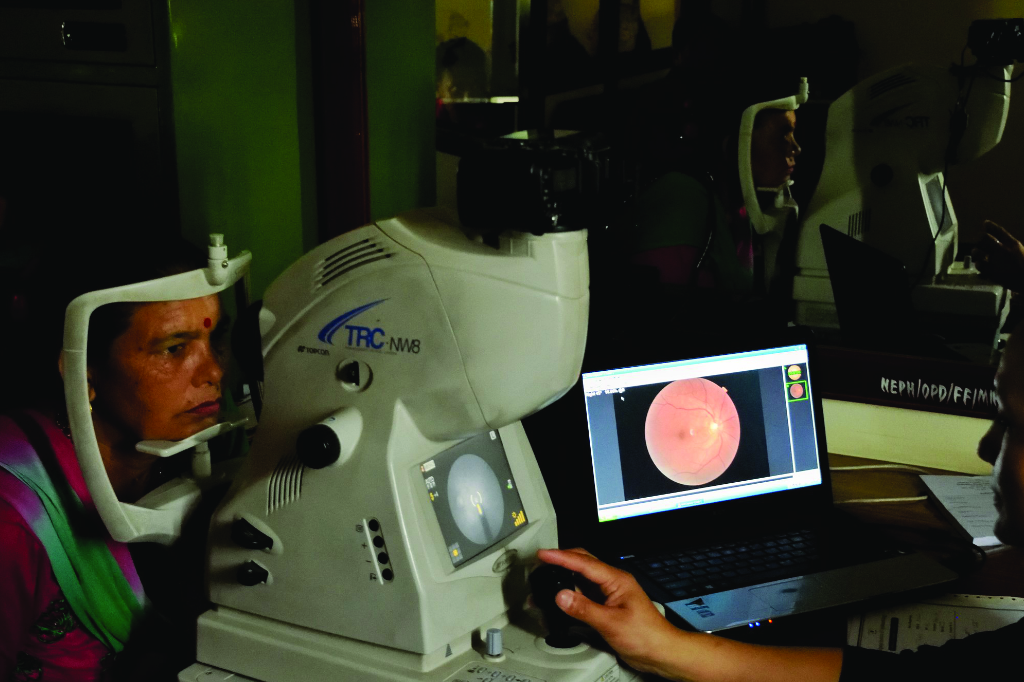
Photo credit: Shyam, Diabetic retinopathy screening at community based hospital, World Sight Day photo competition, CC BY 2.0.
[1] The “Vision for Everyone” resolution was the first agreement designed to tackle preventable sight loss to be adopted by the United Nations. Read more about it here: https://www.iapb.org/news/un-resolution-vision/